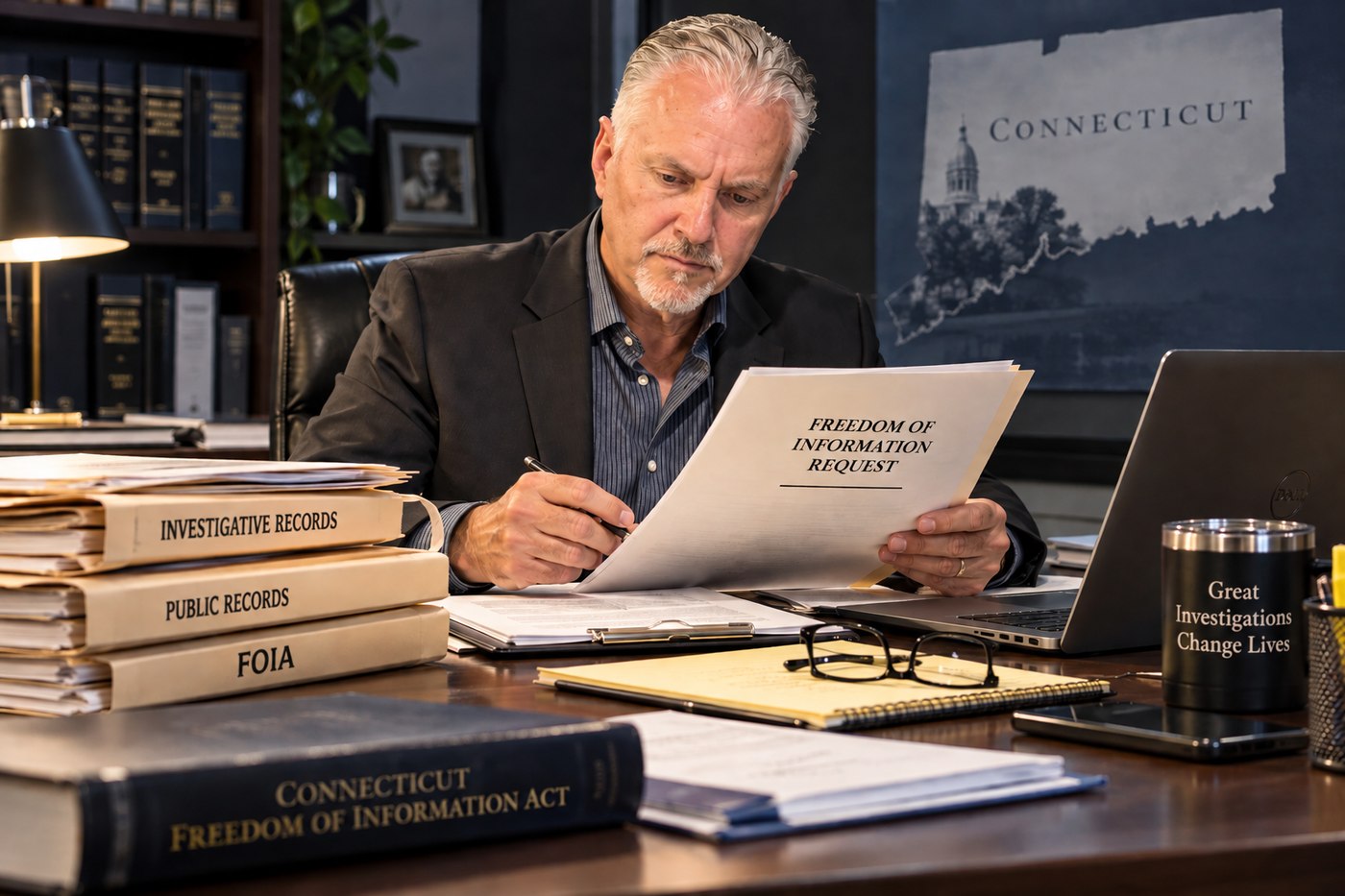
For private investigators, information is often the difference between an allegation and a fact that can be independently verified. Interviews, surveillance, database research, social media, and traditional records searches all have their place in a thorough investigation. But one investigative resource is too often overlooked: the Connecticut Freedom of Information Act.
Connecticut’s Freedom of Information Act, commonly referred to as FOIA, provides broad public access to records maintained by state and local public agencies. Under Connecticut General Statutes § 1-210, records maintained or kept on file by a public agency are generally public records unless disclosure is restricted by federal law, state statute, or an applicable exemption. For private investigators, knowing how to use FOIA effectively can open an entirely different avenue of investigation.
FOIA Is an Investigative Tool
A FOIA request should not be viewed simply as an administrative request for paperwork. Properly used, it is an investigative technique.
Depending upon the case and agency involved, public records may help establish dates, identify people, corroborate or contradict statements, reconstruct events, locate previously unknown witnesses, document governmental actions, and develop additional investigative leads. Records potentially useful to investigators may include police incident and arrest records, supplemental reports, dispatch and CAD information, certain 911 records, body-worn camera recordings, photographs, correspondence, emails, municipal records, permits, inspection records, contracts, meeting minutes, policies and procedures, certain personnel-related records, and other documents maintained by public agencies.
Not every record in these categories will necessarily be released — Connecticut law contains numerous exemptions, and other state and federal confidentiality laws may restrict disclosure. The important point for the investigator is simple: do not assume a government record is unavailable merely because it was not provided to your client or does not appear in the original case file. Ask for it.
Who Can Make a Request?
One of the most useful aspects of Connecticut FOIA is that access is generally not limited to attorneys, journalists, Connecticut residents, or parties to a case. Connecticut General Statutes § 1-210 provides that “every person” has the right to inspect or obtain public records, subject to applicable exemptions — which makes FOIA particularly valuable to private investigators working a criminal-defense investigation, civil case, insurance investigation, workplace investigation, missing-person inquiry, due-diligence assignment, cold-case review, or other lawful investigation. You do not need to convince the agency why you want the records; the focus should instead be on clearly identifying the records you are seeking.
Know What You Are Asking For
One of the biggest mistakes investigators make is submitting an unnecessarily broad request. A request such as “Please provide everything concerning John Smith” may create unnecessary delays and uncertainty. A more effective request might state: “Please provide all incident reports, supplemental reports, photographs, CAD records, dispatch recordings, and body-worn camera recordings relating to the police response to 123 Main Street on January 15, 2026, between 8:00 p.m. and 11:00 p.m.” The Connecticut Freedom of Information Commission recommends articulating the records sought as succinctly and specifically as possible and directing the request to the department that maintains them. There is no universal FOIA request form required in Connecticut, although an agency may have its own form and may ask a requester seeking copies to submit the request in writing.
An important distinction for investigators: FOIA provides access to existing records. It does not require an agency to conduct your investigation or answer investigative questions for you.
Build the Request From the Investigation
Before submitting a request, consider what information you are actually trying to prove or disprove. Suppose a witness claims police arrived at a residence at approximately 9:30 p.m. Rather than relying exclusively on the witness’s recollection, an investigator might seek CAD timestamps, dispatch records, 911 information, body-camera recordings, police reports, photographs, or other records documenting the response — records that may establish a timeline independently of the witness. The same principle applies outside police investigations: municipal building records may establish when work was performed, meeting minutes may establish when a governmental body discussed an issue, emails may document communications among public officials, and inspection records may establish when a condition was first observed. FOIA becomes particularly powerful when it is used to test other evidence rather than merely collect documents.
Think Beyond Paper Records
Modern investigations increasingly involve electronically stored information. Connecticut General Statutes § 1-211 addresses public records maintained in computer storage systems: the law provides that a public agency maintaining public records in such a system shall provide properly identified, nonexempt data on paper or an electronic storage medium requested by the person, including by email, if the agency can reasonably make or have the copy made.
Investigators therefore should not automatically limit requests to traditional paper reports. Depending upon the circumstances, relevant records may include emails, digital photographs, body-worn camera recordings, surveillance video maintained by a public agency, CAD data, electronic dispatch logs, spreadsheets, databases, digital audio recordings, and other electronically stored information. When practical, request records electronically — electronic production is generally easier to search, organize, preserve, transmit to counsel, and incorporate into an investigative case file.
Police Records & the Drumm Decision
Private investigators frequently use FOIA to obtain law-enforcement records, but these requests can be more complicated than requests for ordinary municipal records. Connecticut law recognizes public access to many law-enforcement records while also providing specific exemptions. Depending upon the circumstances, § 1-210(b)(3) may protect particular law-enforcement information involving matters such as witnesses, informants, signed witness statements, investigative techniques not otherwise known to the general public, juvenile information, certain uncorroborated allegations, and information to be used in a prospective law-enforcement action when disclosure would be prejudicial to that action. Records of arrest are also specifically addressed by Connecticut General Statutes § 1-215.
The important point is that the existence of a criminal investigation does not, by itself, make every record associated with that investigation confidential — a distinction that became particularly important following the Connecticut Supreme Court’s decision in Drumm v. Freedom of Information Commission, 348 Conn. 565 (2024).
What “Ongoing Investigation” Really Means
The Drumm case involved the application of Connecticut General Statutes § 1-210(b)(3)(D), which exempts certain law-enforcement records when disclosure would reveal “information to be used in a prospective law enforcement action if prejudicial to such action.” The underlying dispute involved records from a long-unsolved homicide investigation; the agency maintained that the case remained open and that disclosure could prejudice a future prosecution. The Connecticut Supreme Court used the case to clarify the legal standard, concluding that a “prospective law enforcement action” means a future action that has at least a reasonable possibility of occurring — something more than a theoretical possibility, although the agency does not have to establish that an arrest or prosecution is likely or probable. For each document, or set of documents, an agency seeks to withhold under this provision, the agency bears the burden of establishing that it is reasonably possible the information will be used in the prospective action and that disclosure would be prejudicial to that action.
Importantly, Drumm does not stand for the proposition that an old or cold investigative file automatically becomes public — the Supreme Court did not simply rule that all of the requested records had to be released. The Court agreed the “reasonable possibility” standard was correct but concluded the existing administrative record was insufficient to apply it, and remanded the matter for further proceedings before the Freedom of Information Commission. What Drumm does establish is a framework, and the Court identified considerations relevant to cold or long-pending cases: the length of time since the crime occurred, the amount of time since significant new evidence or leads were developed, whether the investigation has effectively become a cold case, the number of investigators assigned to it, the amount of investigative activity occurring, whether a suspect has been identified and whether that suspicion is supported by more than speculation, and whether advances in science or technology, such as DNA analysis, may realistically move the case forward.
For private investigators conducting cold-case reviews, criminal-defense investigations, wrongful-conviction inquiries, civil investigations, or investigations on behalf of victims and their families, Drumm provides an important framework for evaluating an agency’s denial. “This is an ongoing investigation” should not automatically end a FOIA inquiry. An investigation may remain administratively open for years — that fact may be relevant, but it does not by itself answer whether particular records satisfy § 1-210(b)(3)(D). The analysis must be tied to the particular records and the particular exemption being claimed, and when an agency asserts an exemption, determine exactly what is being withheld and why, since different documents, and different information within documents, may raise different statutory issues.
Inspection, Fees & Timing
Connecticut FOIA gives members of the public the right to inspect public records as well as obtain copies. For a private investigator dealing with a potentially large volume of material, inspection can be extremely useful — rather than purchasing hundreds or thousands of pages without knowing what they contain, an investigator may be able to inspect available records first and identify the particular documents needed. The Connecticut Freedom of Information Commission advises that municipal agencies generally may charge a maximum of 50 cents per page for ordinary copies and state agencies a maximum of 25 cents per page; different charges may apply to certified copies, electronic media, transcripts, or other forms of production.
Another area where misunderstandings frequently occur is timing. Connecticut FOIA does not establish a general rule requiring every requested record to be produced within four business days — the statutory standard for access is “promptly,” and what constitutes prompt access depends upon the circumstances, including the volume and complexity of the request, the agency’s workload, the time required to comply, and the urgency of the request. The four-business-day provision serves a different purpose: under § 1-206, a denial of the right to inspect or copy records generally must be made in writing within four business days, and failure to comply with a request within the applicable period can be treated as a denial, allowing the requester to exercise the appeal rights provided by the Act. For investigators, the practical point is that four business days does not necessarily mean production in four business days.
Private investigators should treat FOIA correspondence as part of the investigative record — maintaining the original request, the date it was submitted, proof of transmission, agency acknowledgments, correspondence, fee estimates, records received, explanations of redactions, written denials, statutory exemptions cited by the agency, and follow-up correspondence. Good investigators document not only what they learned, but how they learned it.
When a Request Is Denied
Connecticut FOIA provides an enforcement and appeal process through the Connecticut Freedom of Information Commission. When a request is denied, obtain the agency’s position in writing and identify the specific statutory authority being asserted — do not treat the word “denied” as an explanation. Determine why it was denied. If the denial involves law-enforcement records, determine which portion of § 1-210(b)(3), or what other statute, is being relied upon; if § 1-210(b)(3)(D) is asserted, the Drumm decision should be part of your analysis. A requester who believes rights provided by the Freedom of Information Act have been improperly denied may appeal to the Connecticut Freedom of Information Commission in accordance with the procedures and deadlines established by § 1-206. Because appeal deadlines matter, investigators considering a challenge should consult the current statute and FOI Commission guidance rather than allowing a disputed request to remain unresolved indefinitely.
Another useful investigative technique is to ask: who else might possess a relevant record? A single event may generate records maintained by several governmental agencies — a police department, fire department, emergency communications center, municipal administration, building department, public works department, school system, or state agency. Information obtained from one agency may also identify another document, witness, date, address, government entity, or event that becomes the basis for the next request. This is where investigative experience matters: the best FOIA request is sometimes not the first request.
Ten Practical FOIA Tips for Private Investigators
- Identify the correct agency. Direct the request to the agency or department that actually maintains the records.
- Ask for records, not answers. FOIA provides access to existing public records; it is not an interrogatory requiring the agency to conduct your investigation.
- Use dates whenever possible. A defined time period can make a request considerably easier to identify and process.
- Identify the incident. Names, addresses, case numbers, report numbers, vehicle information, and other identifiers may help locate responsive records.
- Think digitally. Consider email, video, audio, CAD, photographs, databases, and electronic records, not just written reports.
- Request related records separately when useful. Several focused requests may sometimes be more effective than one enormous request for “everything.”
- Ask for electronic copies when practical. Electronic records are generally easier to preserve, search, organize, and review.
- Document everything. Maintain the request and the agency’s complete response as part of the investigative file.
- Read the cited exemption. If something is withheld, determine precisely what statutory authority the agency claims permits withholding it, and remember the significance of Drumm when § 1-210(b)(3)(D) is asserted.
- Follow the evidence. A record obtained through FOIA should generate investigative questions just like an interview, surveillance observation, photograph, or other piece of evidence.
The Investigator’s Advantage
The real value of Connecticut FOIA is not simply access to documents — it is the ability to independently verify information. A witness may forget. A client may have received only part of the story. An investigative report may omit something. Two people may give completely different accounts of the same event. But a timestamped CAD entry, contemporaneous email, government photograph, meeting record, dispatch recording, body-worn camera recording, or other independently maintained public record may provide an objective reference point against which those accounts can be evaluated.
That is why Connecticut’s Freedom of Information Act belongs in the private investigator’s investigative toolbox. Knowing that a record exists is useful. Knowing what record to ask for, where to find it, how to request it, how to evaluate an asserted exemption, and what to do with the information once you obtain it is investigation.
Resources for Connecticut Investigators
Investigators using Connecticut FOIA should become familiar with three primary authorities: the Connecticut Freedom of Information Commission, whose website provides guidance on obtaining records, frequently asked questions, Commission decisions, court decisions, the FOI Act, regulations, and information concerning the complaint and appeal process; Connecticut General Statutes, Chapter 14, particularly §§ 1-200, 1-206, 1-210, 1-211, 1-212, and 1-215; and Drumm v. Freedom of Information Commission, 348 Conn. 565 (2024), particularly important when a law-enforcement agency invokes § 1-210(b)(3)(D) to withhold records associated with an open, ongoing, or cold criminal investigation. For investigators who regularly seek government records, these should not simply be legal references — they should be part of the investigative toolbox.
This article is intended for general informational and investigative-education purposes and does not constitute legal advice. Connecticut FOIA requirements, exemptions, procedures, statutes, and court decisions can be fact-specific and may change. Investigators should consult current statutes, Freedom of Information Commission decisions and guidance, applicable case law, or legal counsel when appropriate.

Don DiStefano is founder of Madison Investigative Services and a retired Detective-Sergeant with the Vallejo Police Department in California. He currently serves as Captain and Director of Investigations at Quinnipiac University and as President of the Connecticut Private Investigators Association. Read Don’s full bio →
Discussion